
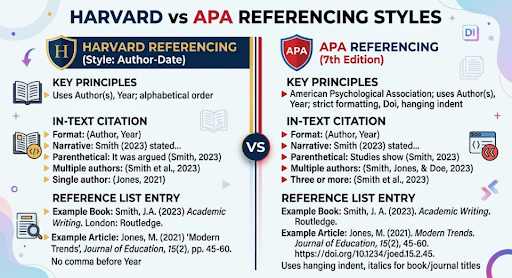
The choice between Harvard vs APA referencing is one of the initial practical choices a postgraduate student has to make as soon as the actual writing process begins.
Despite the fact that both formats have something common in them, namely, the use of the author name and date of publication.
They have their own rules for spacing, punctuation and source ordering that are different enough to lose some points when examiners see that there are some mistakes in citing sources.
This article will help you learn both formats in detail, so you can apply the right academic citation layout from your first draft rather than reformatting an entire bibliography the night before submission.

Understanding Harvard British Standard Format
The citation style of the Harvard British Standard format as described by UCL is quite common in educational establishments in the UK for disciplines such as business, law, and social sciences.
Apart from in-text citation using the author-date format, there should be an alphabetised list of all sources used at the end of the document.
The general format of an in-text citation is (Smith, 2021, p. 45). It is important to note that the format used by the British style prefers the use of a comma before the page number and does not include the word “pp.” where there is only one page.
The format used in the bibliography will further elaborate on the citation. The reference list record elaborates in full bibliographic detail on the abbreviated information with details like the name of the publishing company and the location of its publication, which most American referencing styles present differently or omit.
But there is also something that creates problems for many students concerning the format, and that is the citation method for multiple sources written by a single author in one particular year in the Harvard style of referencing.
In such scenarios, the year is followed by lowercase letters, such as (Smith, 2021a) and (Smith, 2021b), and this same labelling must then be mirrored precisely in the reference list.
Understanding APA 7th Edition Guidelines
The APA 7th edition guidelines are used across psychology, education and health sciences. Both Harvard and APA styles use an author-date system but have distinguished formatting styles that are easily confused.
APA 7 has the in-text citation like (Smith, 2021, p. 45). Use of the ampersand “&” instead of “and” for citations enclosed within parentheses in the case of two authors, whereas “and” is used for citations within a sentence.
The reference page, referred to as “References” and not “Bibliography”, employs hanging indentation and requires using a DOI or URL for online sources when available, even though most institutional variants of the Harvard system treat them as optional.
The latest American Psychological Association 7th Style Manual includes new guidelines on inclusive language usage and author name lists that do not exceed twenty authors before the use of the ellipsis becomes necessary.
The new guidelines also include simplified web page and social media post citation rules. This shows research today now draws on digital sources.
Key Differences in Academic Citation Layout
Both systems share a family resemblance, but the practical academic citation layout differs in several areas that matter for thesis bibliography rules:
- List title: Harvard often uses ‘bibliography’ or ‘reference list’. Meanwhile, APA uses ‘references’ always.
- Publisher location: Harvard mostly demands the place of publication before the publisher’s name. APA 7 has removed this requirement completely.
- Page number style: Harvard commonly uses “p.” or “pp.” before page numbers. APA follows the same convention but applies it more consistently across source types.
- Source inclusion: Harvard bibliographies sometimes include background reading that was not directly cited. APA reference lists should only contain sources that are actually cited in the text.
- Punctuation between elements: Harvard uses full stops between reference elements. APA relies more on commas within a structured template.
By knowing the thesis bibliography rules beforehand, one will be saved from the agony of rewriting at the last moment, especially those students who are working in multiple disciplines which mix conventions from different departments or supervisors.
Endnote Reference Formatting and Why It Matters
Certain universities, particularly law schools and schools of humanities, demand endnote reference formatting instead of the parenthetical author-date system favoured by Harvard and APA styles of referencing.
Written as a superscript number in the text, while the full reference is written at the end of the chapter or the document.
In instances where the thesis adopts Harvard or APA as the main citation style, supervisors may allow for the use of endnotes to offer explanations for added commentary that otherwise would interrupt the argument flow.
Here, consistency becomes key. Using both footnote numbering and the author-date referencing system in the same chapter will only confuse the examiners and must be clarified with the supervision prior to submission.
Common In Text Citation Errors to Avoid
Markers report the same handful of in text citation errors across nearly every discipline:
- Citation of a reference within the text without mentioning it in the final list of references or vice versa.
- Incorrect capitalisation of titles, especially alternating between sentence case and title case within the same reference list.
- No inclusion of page numbers in direct quotations, which is mandatory in both the Harvard and APA citation styles.
- Incorrect use of “and” and the “&” ampersand sign for authors’ names within and outside the parentheses.
- Wrong alphabetisation in the event where an author has both single-authored and co-authored publications.
A thorough proofreading pass focused completely on citations, different from a check for grammar or argument structure, finds most of such mistakes before submission.

Which Style Should You Choose?
In most instances, it is not entirely up to the student, since educational institutions usually dictate the type of citation style to be used for the sake of consistency and disciplinary standards’ adherence.
In this regard, departments or supervisors clearly dictate the use of either the Harvard citation style or the APA citation style in the thesis manual, and compliance is more important than personal preference between the two styles.
This is mostly because citation styles are not just about appearances. Citation styles play an essential role in improving academic writing style by making the sources easily identifiable and helping the writing to be structured in a manner that is recognisable and comprehensible within the field.
Where there is an actual choice available, like in some interdisciplinary courses where there is an emphasis on mixing methodologies and styles of scholarship, Harvard style works well.
Especially for areas where there is an emphasis on books, monographs and thorough reports because the structure usually provides room for bibliographies and detailed referencing of multiple sources.
However, the APA style, with its simplicity and the use of the author-date citation system, is very suitable for those areas of knowledge which rely on journal publications and research where up-to-date information becomes crucial for understanding new discoveries.
Thus, the selection of the citation style will have a significant impact on the presentation of the research and will affect its credibility, thus emphasising the importance of strictly adhering to the citation guidelines to ensure the credibility of the research process and develop clear scholarly discussion.
Manuscript Layout Standards Beyond Referencing
Referencing style is only one part of a wider set of manuscript layout standards that examiners assess.
However, margins, line spacing, font sizes, numbering of chapters, and positioning of tables/figures are all done based on institutional guidelines that often co-exist with Harvard and APA styles instead of replacing them completely.
The referencing style itself is just one aspect among many other rules that are taken into consideration with regards to manuscript layout formatting.
These aspects include margins, line spacing, font size, chapter numbering, and positioning of the tables and figures in accordance with institutional guidelines that often exist side by side with the Harvard/APA guidelines rather than replacing them.
Thesis work which is accurate in terms of citations but fails to comply with the university’s standards concerning margins and pagination is bound to get rejected as well, so it makes sense to check both aspects before final submission.
Additionally, the significance of complying with such formatting rules cannot be stressed enough, since not only do they demonstrate the professional approach of the writer, but they have a great impact on the readability of the thesis as well.
Examiners have to go through several applications, and the one that is nicely organised and formatted will create a positive impact on the examiner, and the substance of your application will stand out.
Apart from the above technicalities, writers ought to consider the logical sequence of their works, which means that headings and sub-headings must be properly defined and sized in accordance with the guidelines offered by their universities.
This level of attention allows for easy navigation of the paper, making it possible for the reader to find the relevant parts of the paper and get acquainted with the presented argument structure.
The placement of tables and figures cannot be seen as a mere issue of aesthetics once more. It is important that they are placed near the appropriate text to provide context, along with suitable captioning and referencing in the manuscript.
These are important not only to increase clarity but also to indicate scholarly rigour. To conclude, although it is extremely important to comprehend the complexities of different citation styles, it is just as important to pay attention to all the formatting rules that your university requires.
As authors strictly follow the norms of citing and formatting, they not only increase their likelihood of receiving a positive assessment but also take part in academic discussion in a professional manner.
Getting Support With Referencing and Beyond
Referencing consistency is one of the most time-consuming aspects in completing the thesis process, and it is very easy to waste time on formatting rather than spend it on analysis and developing an argument.
Even while formulating the research question, advice from professionals regarding a thesis proposal can provide the proper framework and structure, including referencing requirements, right from the very beginning of the process.
If the student needs some assistance in writing his or her paper, whether it concerns the structure of the chapter, the development of argumentation or the revision of the draft, the student can also buy thesis online.
Consult a professional company like Thesis Writing Services UK offering academic writing services, provided that the purchased product is to be used for consulting purposes and not for cheating.
Frequently Asked Questions
The Harvard referencing system is commonly used in UK institutions, especially within the schools of business, law, and social sciences. However, in the fields of psychology and health sciences, the APA format is still used. Your department’s guidelines will indicate which referencing system is to be used in your thesis.
No, it is not acceptable to cite using two or more styles in one paper. In case of usage of sources belonging to other fields of science, it would be better to consult your tutor and find out which style should be used throughout the entire paper.
The distinction is mostly in terms of the formatting aspect. APA references have the title “References”, follow the strict hanging indentation format, and include DOIs where possible, whereas Harvard references usually have the title “Bibliography”, can include background references not cited in the text, and include publisher locations differently.
Perform an individual citation check independent of your overall proofreading, where you compare all the in-text citations with your reference page to make sure that every citation is reflected in both areas with correct information. Reference management programmes like Zotero or EndNote can also help you identify missing citations or duplicate citations.
Yes, in fact, all universities’ marking criteria include some marks allocated to proper referencing, independent of the marks allocated to the content and the argument presented. The use of erroneous citations, on the other hand, may also imply lack of academic integrity even when not intentional, so accuracy matters beyond the mark allocation itself.
Get Expert Writing Support
The key factor that will help you choose between Harvard vs APA referencing formats is making sure that you use all your institution’s guidelines consistently throughout all your references.
Be it that your faculty uses the Harvard British format style, the 7th edition APA format, or a blend of both using EndNote reference formatting, the basic aim of all this is to ensure that the structure of the citation used is accurate without any errors that let your research speak for itself.
The correct way will save you from last-minute reformatting stress and your marks as well, so start building your referencing style from the very beginning of writing your draft.
Should you want someone professional to check out the referencing, structure of chapters, and thesis proposal altogether, Thesis Writing Services team can be of great assistance. Contact us today for free to get expert guidance.